Best Outdoor Toys for Toddlers: Water Table vs. Sand Pit
The Barefoot Bub may earn a commission from links on this page. We choose products independently.

For most toddlers, a water table edges out a sand pit as the better first outdoor toy — it sets up in minutes, cleans up faster, and works for younger toddlers who still mouth everything. That said, a sand pit pulls ahead for open-ended, imaginative play in the 2–4 age range and holds a child's attention longer per session. Read on to see which one fits your yard, your kid, and your sanity.
You've decided your toddler needs more outdoor play time — great call. The research on unstructured outdoor play for young children is genuinely compelling, and getting kids moving and creating outside from an early age builds habits that stick. But then you hit the toy aisle (or the endless scroll of Amazon) and suddenly you're paralyzed between a water table and a sand pit, both promising hours of independent play. Both are classics for a reason. And both have real trade-offs that nobody seems to talk about honestly. We've dug into what actually matters for families who spend time outside regularly, so you can make the call that works for your specific situation.
Verdict: Which Wins Per Use Case
Before we go dimension by dimension, here's the quick answer. If your toddler is between 12 months and 2 years, or you're in an apartment or rental with limited outdoor space, go with a water table. It's lower commitment, easier to store, and developmentally perfect for that age window. If your child is 2 years or older and you have a dedicated outdoor space — a yard, a patio, a permanent garden area — a sand pit is the better long-term investment. It grows with your child, encourages deeper imaginative play, and honestly keeps kids busy longer. If budget allows and you have the space, many families end up with both. But if you're picking one, those are the lanes.
Sensory Value and Developmental Payoff
Both water tables and sand pits are sensory goldmines for toddlers, but they deliver differently. Water play is immediate and cause-and-effect heavy — pour, splash, watch it drain. This is fantastic for 1–2 year olds who are still figuring out how the physical world works. The feedback is instant, which matches their short attention spans and developmental stage perfectly. Pouring water between cups teaches early math concepts like volume and quantity without a single worksheet involved.
Sand play, on the other hand, is slower and more open-ended. A 2-year-old fills a bucket and dumps it. A 3-year-old builds a road. A 4-year-old creates an entire village with roads, rivers, and inhabitants with names. Sand scales with imagination in a way water simply doesn't. The sensory texture — cool, dense, moldable — also offers something uniquely calming for many toddlers, including kids who find other sensory input overwhelming.
For younger toddlers (12–24 months), water wins on developmental fit. For the 2–4 range, sand wins on depth and longevity of engagement.
Edge: Sand pit (for toddlers 2+); Edge: Water table (for 12–24 months)
Setup, Storage, and Real-Life Maintenance
This is where honest parenting advice matters most, because both options sound great in theory and involve real work in practice. A water table is genuinely low-friction: fill it with a hose, play, drain it, fold it up or tip it upside down. The main annoyances are algae if you leave standing water for days (drain it after each use and you're fine) and the fact that your toddler will be soaked within four minutes. Pack a spare outfit. Done.
A sand pit is a different level of commitment. Sand gets everywhere — in shoes, in the kitchen, in your bed somehow. A covered sand pit is essential to keep out neighborhood cats, rain, and debris, which means you're shopping for a cover or a pit with one built in. You'll also need to refresh the sand periodically. Budget for a bag of play sand every season or two. On the upside, once it's set up and positioned, it basically runs itself. Kids gravitate to it naturally, and you're not refilling it every session the way you are with water.
If you move frequently or have a small outdoor space: water table wins. If you have a permanent yard and don't mind initial setup effort: sand pit pays off over time.
Edge: Water table
Longevity and Age Range
A good water table gets about two solid years of heavy use — roughly 12 months to 3 years — before kids start finding it a bit basic. You can extend the life by adding tools, containers, and toys (colored ice cubes are a hit), but the novelty curve is real. Sand pits, by contrast, stay relevant from around 18 months well into the early school years and beyond. Kids at 5 and 6 are still deeply invested in sand play, especially when you provide good tools: molds, trucks, small shovels, and containers that spark new scenarios. If you're thinking about value per year of use, sand pulls ahead clearly.
Edge: Sand pit
Who Should Buy Which
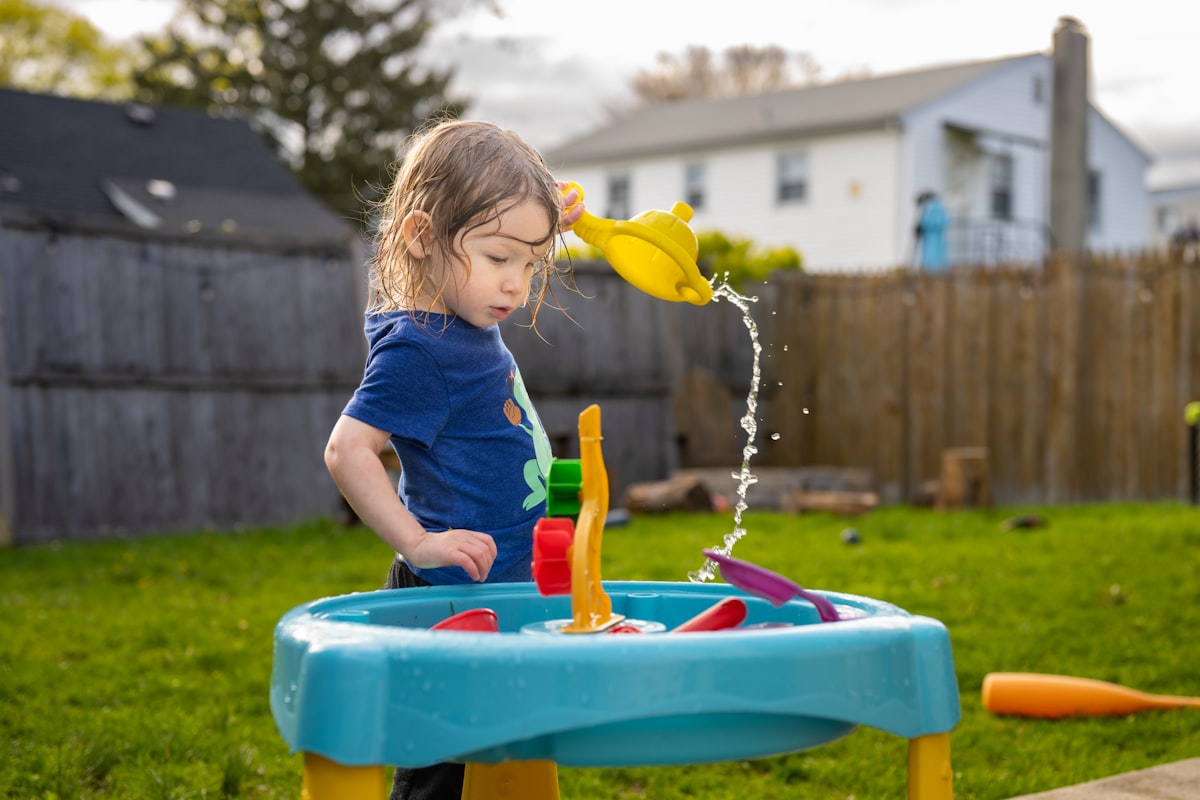
Buy a water table if: your toddler is under 2, you're renting or moving within a year, you have a small balcony or patio, you want something that stores in a garage or shed over winter without hassle, or your child is in an oral-exploration stage and you're not comfortable with sand yet. Buy a sand pit if: you have an outdoor space that's yours to use long-term, your toddler is 2 or older, you're looking for one toy that will carry you through the preschool years without being replaced, and you're okay with a little sand tracked inside (it's worth it, we promise).
Step2 Waterwheel Activity Play Table
A perennial favorite for a reason — this water table has a working waterwheel, two splash zones, and enough room for two toddlers to play side by side without a meltdown. It drains easily, stores flat, and the bright colors hold attention without being chaotic. A solid entry point for families dipping a toe into outdoor sensory play.
View on Amazon →Little Tikes Turtle Sandbox
The shell lid does double duty as a play surface and a cover that keeps critters and rain out — genuinely the most practical design detail in the sandbox world. It holds enough sand for two kids, has a comfortable depth for digging, and is light enough to reposition in your yard as the seasons change. A classic for a reason, and still one of the best value options in 2026.
View on Amazon →Honest Drawbacks for Both
We'd be doing you a disservice if we only sold the upside. Water tables have a shorter play window per session — toddlers often max out at 20–30 minutes before they're bored or soaked through. They're also less useful in cool or cold weather, cutting your usable season depending on where you live. The standing water issue is real if you're not diligent about draining. And if you have more than one child, the table can feel small fast.
Sand pits come with legitimate cons too. Sand gets into everything — there's no version of sand pit ownership that doesn't involve vacuuming grit off your floor. Uncovered pits become neighborhood litter boxes quickly. Sand can harbor bacteria if it gets wet and stays wet, so drainage and covering matter. And the initial cost of filling a pit with quality play sand adds up if you're buying a larger size. Go in with clear eyes on both fronts and you won't be disappointed.
Frequently Asked Questions
Add these picks to your The Barefoot Bub registry
Build your outdoor childhood kit with everything we recommend.
Start Your Registry